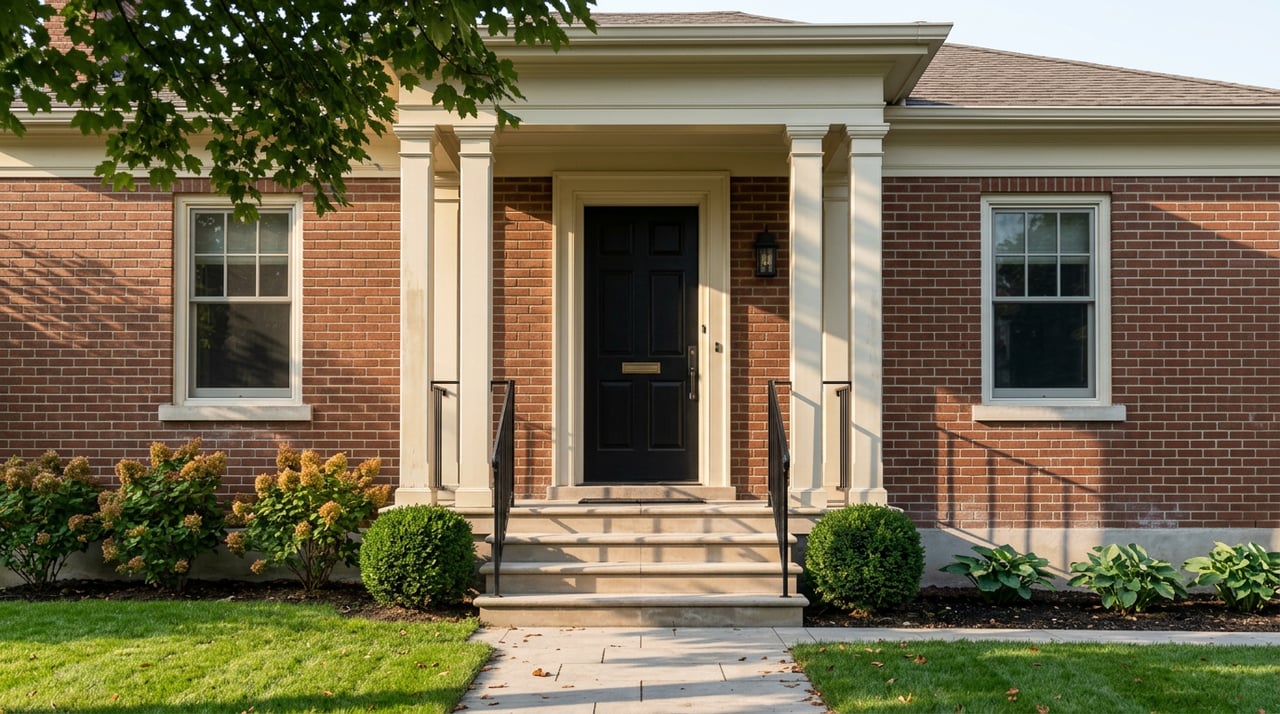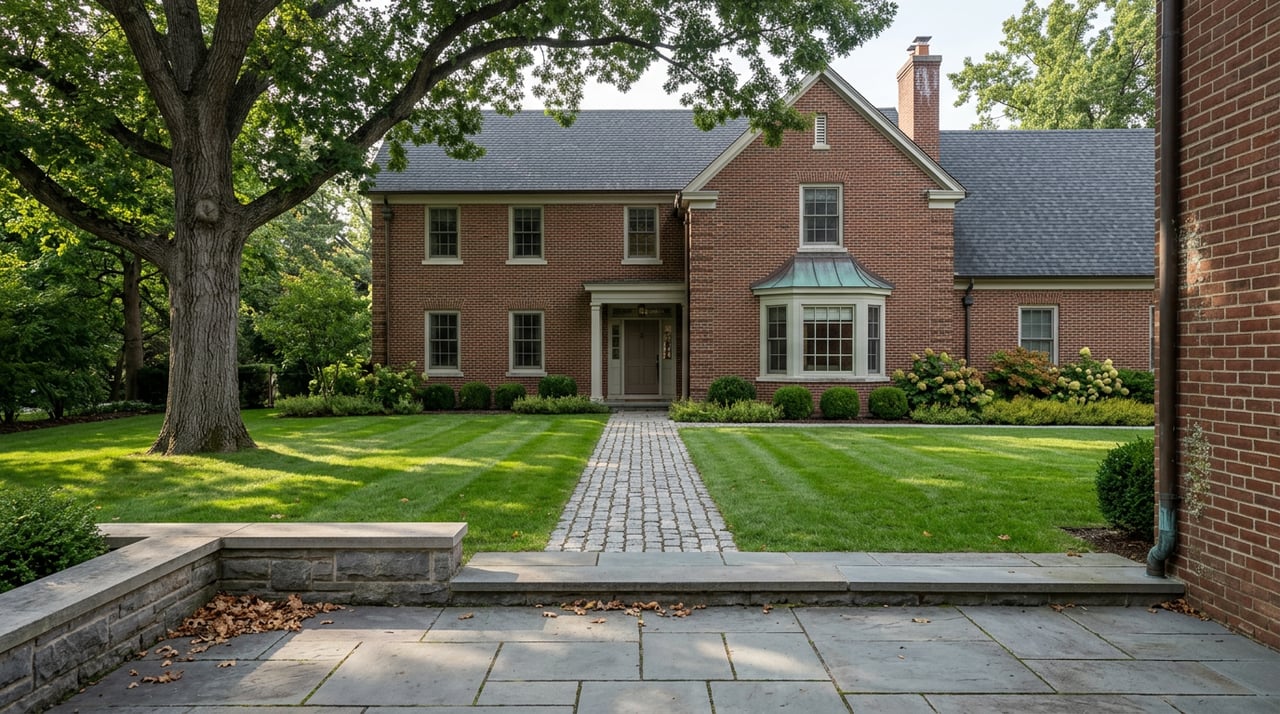
Every street in Joshua Creek was drawn from roughly the same set of subdivision maps, in roughly the same stretch of years, by production builders working the ground between Eighth Line and Ninth Line one phase at a time. Walk any block off Dundas and the pattern repeats itself: two-storey homes from the late 1990s through the 2000s, mature enough now to have real trees in the yard but not old enough to predate the community that planted them. The character here comes from landscaping and renovation, not architectural variety, because almost nothing in the subdivision itself predates the mid-1990s.
Follow the Joshua's Creek Trail north from Dundas Street and that pattern breaks. Past the last cul-de-sac and a stretch of ravine, the trail runs directly to a farmhouse and barn built in 1827, forty years before Confederation and more than a century and a half before the first foundation went in on the street behind it. It is still standing, still in use, and still open to anyone who walks or bikes up to the door on the right afternoon. Most residents have passed the turnoff without knowing what waits at the end of it.
A Neighborhood Built On One Timeline, Except Here
Joshua Creek's identity is its consistency. Predictable lot sizes, a school lineup residents can recite before they can recite a street name, a trail system engineered into the original plan rather than added later. That consistency is real, and it is part of what makes the community work day to day. But it also means the neighborhood has almost no visible history older than its own residents.
Compare that to Old Oakville, where a house might still carry a datestone from the 1850s, or to the working waterfront in Bronte. Joshua Creek does not have that layer, with one exception: twelve acres at 1086 Burnhamthorpe Road East, where an 1827 house and barn sit inside their own preserved valley, untouched by any of the phase maps drawn around them.
What Sybil Rampen Turned An Old Farm Into
The property is the Joshua Creek Heritage Art Centre, founded by artist Sybil Rampen. The barn functions as a gallery. The house holds a private library and research collection that includes the Amice Calverley collection and the David Horne architecture library, a pairing that would be unusual to find anywhere in this part of Oakville, let alone inside a subdivision built in the 1990s. The centre runs almost entirely on volunteers, and one visitor summed it up on Tripadvisor simply as "an Oakville institution," which, given how far the property feels from everything built around it, is not an exaggeration.
Admission is free. The centre asks for donations rather than charging a fee, and according to visitor accounts, volunteers will walk a guest from the gallery into the working studio to explain what is being made that week. As of a recent listing update this year, the centre is open Tuesday through Sunday, 1 to 4 p.m., closed Mondays.
The Calendar The Centre Actually Runs On
The Art Centre does not run event marketing the way a museum with a communications budget would. It runs on a rhythm that has settled into close to the same shape most years:
- A members' exhibition each summer, showcasing work made by the centre's own community of artists rather than a touring show brought in from elsewhere
- An open house, typically held in June, when the grounds and gallery open without appointment and volunteers walk visitors through what the centre actually does day to day
- A Handmade Market, typically held on a Saturday in November, timed for holiday shopping and built entirely around local makers rather than retailers
The summer members' show is where the texture actually lives. One past edition hung Matthew Morgan Garby's "The Sewing Lesson," Michelle Chen's "Rose Wine," Bhumika Varma's "Poppy Pods in Space," and Kimberly Bell Schols's "Flight of the Lake Dancers," work made by people who live in or near this community, displayed inside a barn that predates the neighborhood around it by a century and a half. The names on the wall change year to year. The fact that the wall itself is inside an 1827 barn does not. None of this shows up on a subdivision map or a builder's brochure. It shows up only if you check the centre's own calendar before you plan a walk.
Where The Trail Actually Puts You
Joshua's Creek Trail is one of the Town of Oakville's designated heritage trail systems, built to move people, not just to sit as a strip of green on a plan. The northern section runs from Dundas Street down to Parkway Park near the Crosstown Trail, following Joshua's Creek itself, and the trail extends specifically north to the Heritage Art Centre. A separate southern section picks up from Arkendo Park and runs north to Brookmill Road along the same watershed on its way to Lake Ontario, with an information kiosk near the Southeast Sports Field that covers the valley's habitat and its agricultural history.
What that means in practice: a resident starting from almost any park along the corridor, Arkendo, the Southeast Sports Field, or one of the smaller pocket parks feeding into the ravine, can end up at the door of a 200-year-old farmhouse without ever leaving a trail built for stroller walks and after-dinner loops. The centre is not a destination anyone drives to. It is a destination people happen upon, if the trail takes them far enough north.
Why This Is Worth Knowing, Even If You Never Go
Every established neighborhood accumulates one landmark that does not fit its own timeline. Old Oakville has its harbour and its century homes. Bronte has its working waterfront. Joshua Creek, a community defined almost entirely by its uniformity, has a farmhouse and a barn that were standing before the town of Oakville itself was incorporated, tucked into a ravine the subdivision was built around rather than over.
Knowing the centre exists changes how the neighborhood reads. It is not proof that Joshua Creek is secretly older than it looks. It is proof that the ravine running behind these streets was worth preserving before anyone was building homes here at all, and that the trail connecting those streets was drawn on purpose to include it. The next walk on Joshua's Creek Trail is a different walk once you know what is waiting at the north end of it.
For more on how the older bones of Oakville's neighborhoods still shape daily life on streets built decades later, Niblock Real Estate works these micro-markets block by block. If a specific Joshua Creek property is on your mind, sooner or later, Book a Discovery Call and we can talk through what it is actually worth today.